The Experiment That Never Happened
Content note: This post discusses economic abuse.
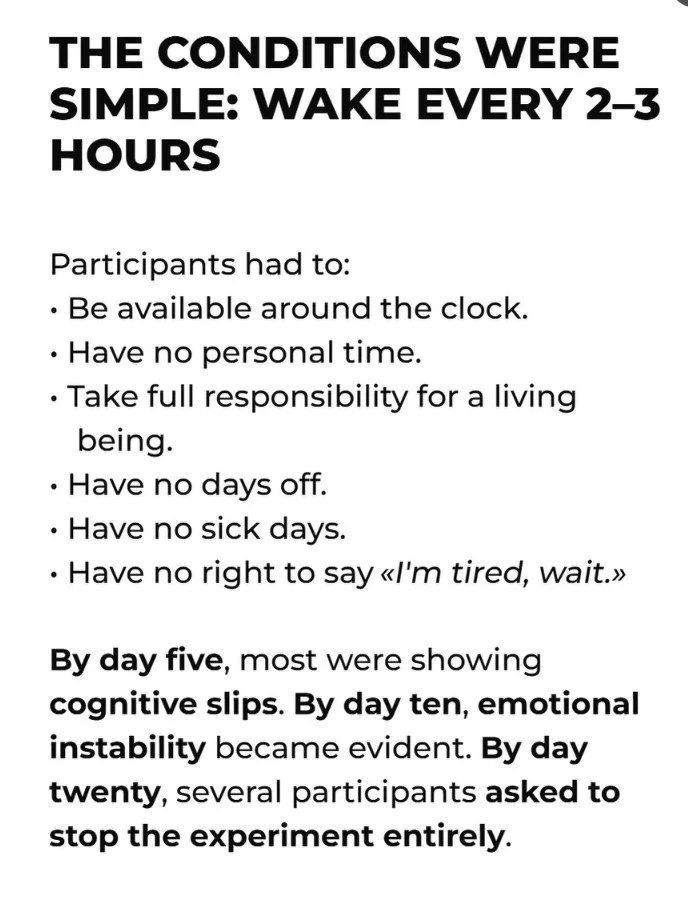
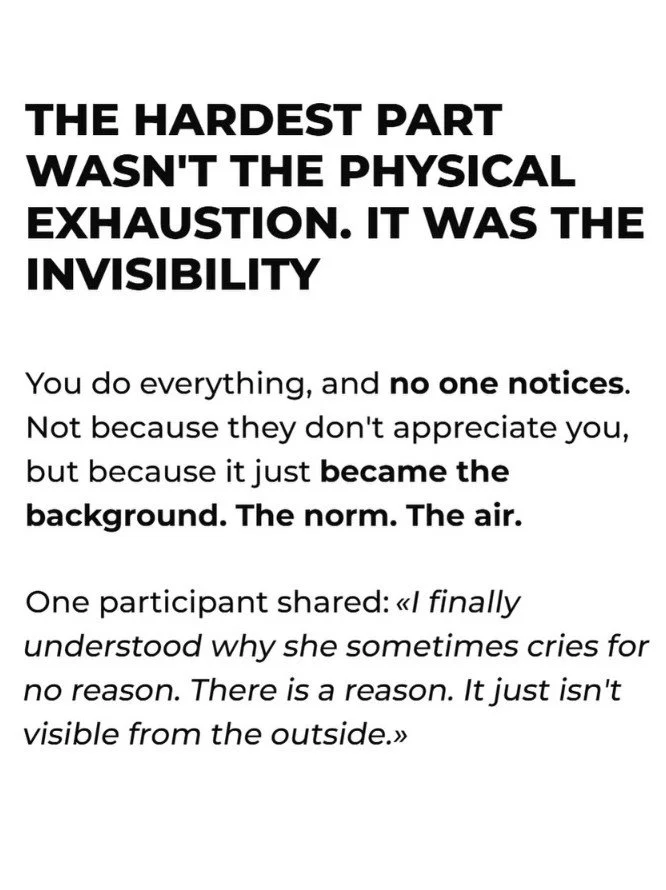
I was scrolling through Instagram the other day and I came across a post that piqued my interest, because it talked about healthy men, regular relatable guys, who took part in an experiment that made them live a mother's routine, to experience as closely as they could what it's like for us [1]. They were woken every two to three hours, they had to be available 24/7, they had no personal time, they weren't allowed any days off, they weren't allowed sick days, they just had to plough on through even if they were poorly. They couldn't say "I'm tired, just wait."
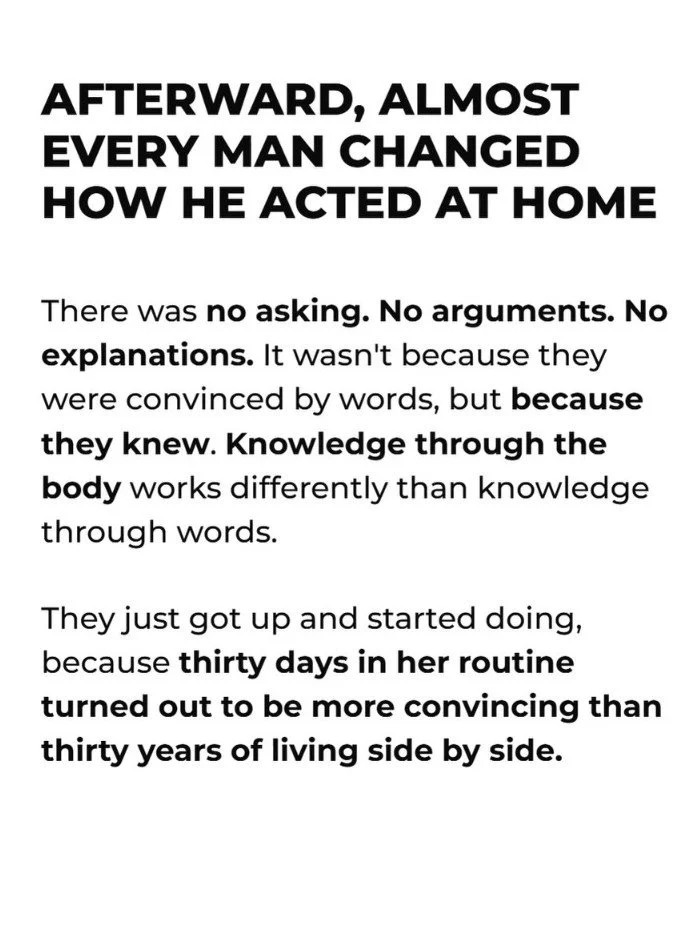
That "hook" was what made me swipe to the next image in the carousel. By the fifth day these men were experiencing brain fog, or I guess the real term for it is cognitive slips, and by day ten they were crying, which is probably called emotional instability by the professionals. I'm not sure quite how many, but several of them had asked to stop completely by twenty days, and eventually the whole experiment was called off at thirty days, when it was supposed to run for three months [1]. It really resonated with me, and I'm sure every other mother out there, that afterwards "none of these men could talk about his wife the same way again". It's what we as women have been trying to explain to our husbands for thousands of years: that it's so bloody difficult to be a mother 24/7 for endless years and years and years.
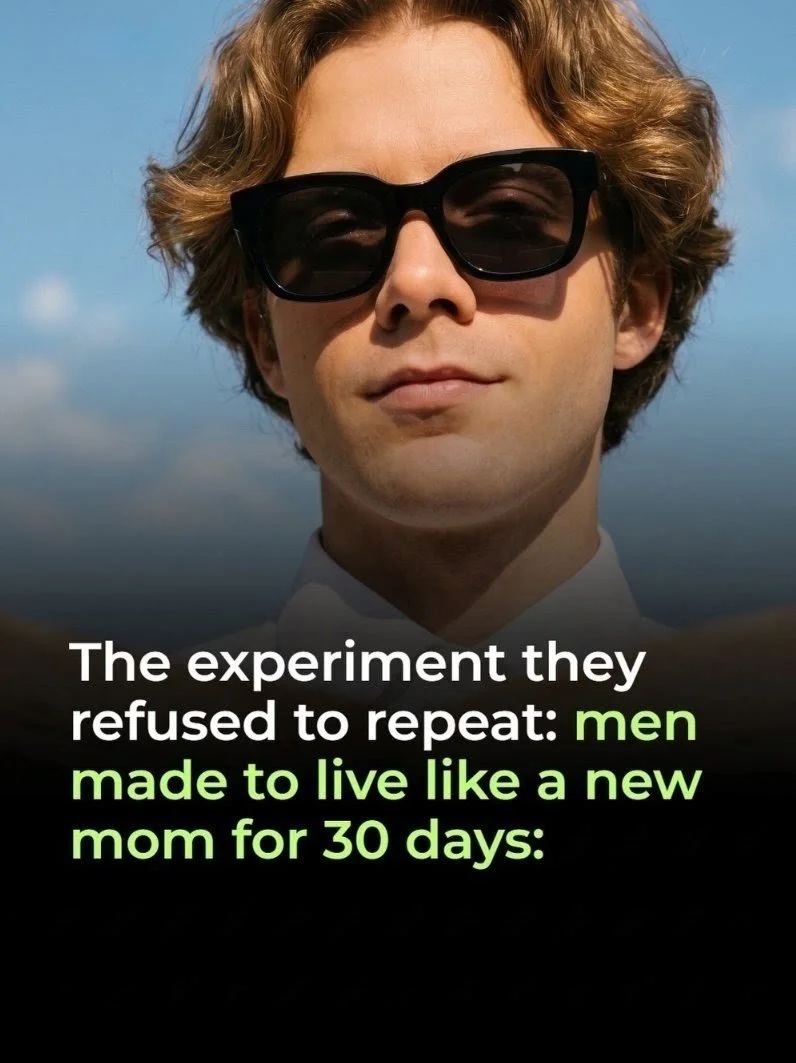
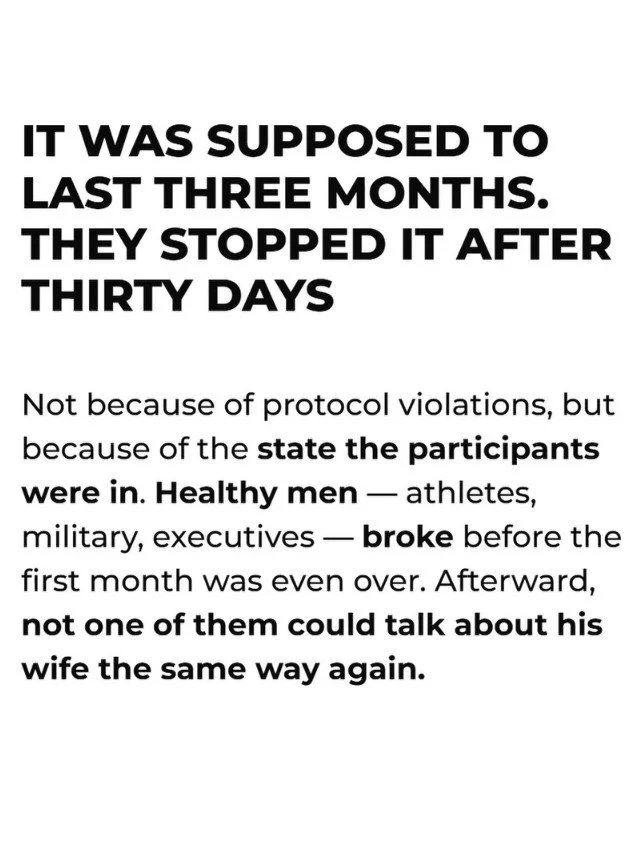
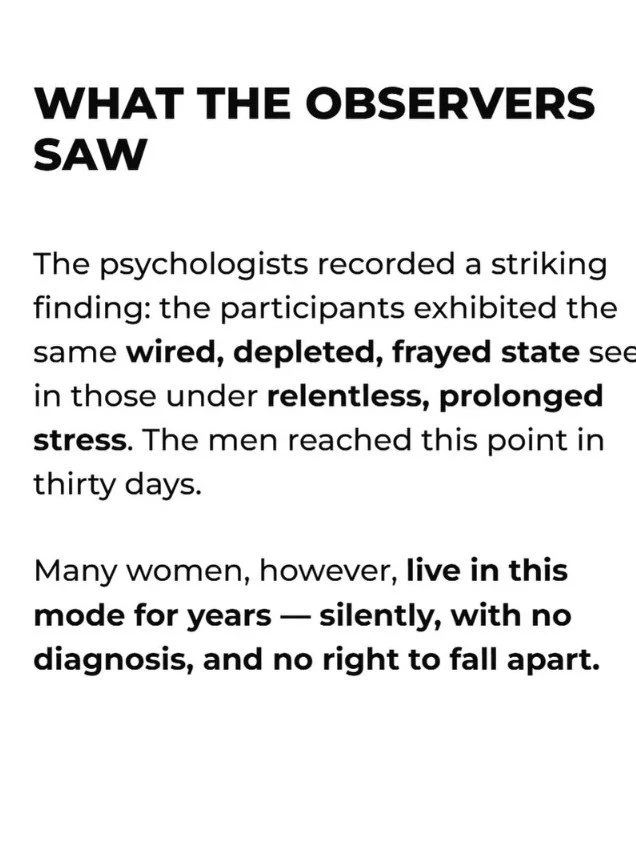
I looked at the stats on the post and it had thousands of likes, hundreds of reposts and thousands of shares, unsurprisingly, because it pulled on the heartstrings [1]. I was surprised that I hadn't heard of this before, so I looked and looked, searching the web with different terms, trying different sources. I searched in different countries, and I just couldn't find anything anywhere. Absolutely zero, zilch that even nearly matched this "study". Very odd, because when I checked back on the post it had definitely said it as a fact. "The psychologists recorded a striking finding", "participants", "observers", "science-backed" [1].
So initially I just thought that I was struggling to find the info, but actually what I did find was even more interesting. After a bit more digging, I discovered that it seems to come from an internet horror story in 2009 about prisoners in the Soviet Union. They were kept awake for fifteen days with some kind of gas, but it turns out even this wasn't true! Snopes debunked it in August 2013 [2]. So the experiment turned out to be completely made up. Not just substituting the prisoners in this experiment for fathers, as I'd initially thought, but the prisoners in the original "experiment" were also fake. The whole thing from beginning to end was complete fiction, made to grab attention and then just used as a sales tool.
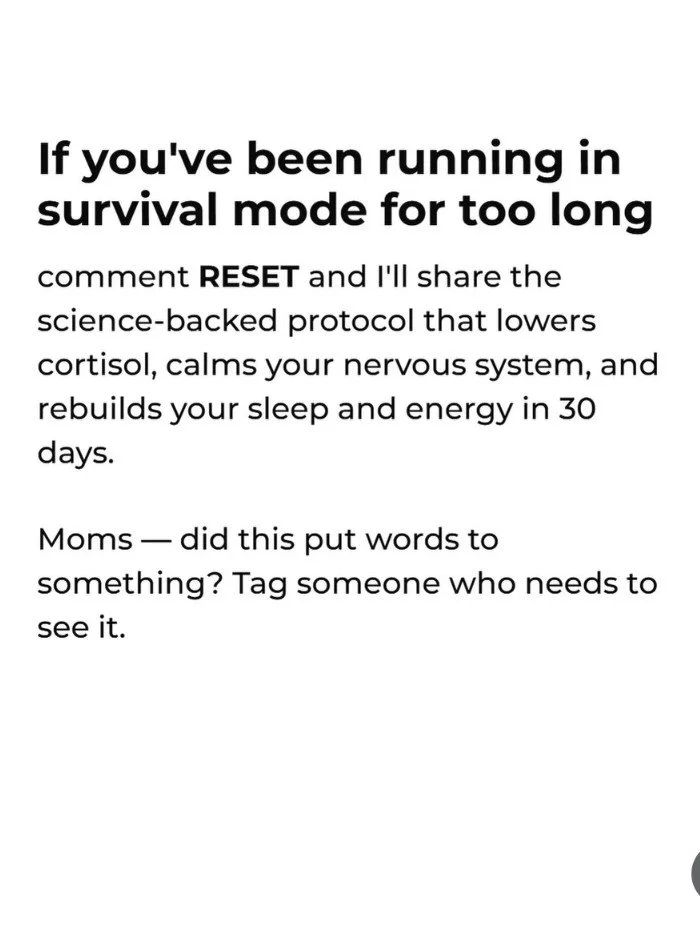
And when I reached the final slide, I realised why… because it asks you to comment RESET on the post, to be sent some science-backed blah blah blah that can fix cortisol in thirty days [1], which of course turns the whole thing into a blatant sales pitch. As soon as I saw that, it clicked that it was just a really bloody good advert. It works so well because it hooks into a real emotion that every mother feels. Suddenly we're all agreeing with the post wholeheartedly, and by the time we get to the end we're (almost) fully sold. I went back to have another look and the post seems to have gone, or been changed, but the page it came from has 268,000 followers and 1,327 posts, and every single one of their posts follows the same sort of marketing idea and sales pitch. The profile describes itself as a science-backed reset for anyone exhausted for years, and every post shows a handsome looking man talking about women and family and social issues [1].
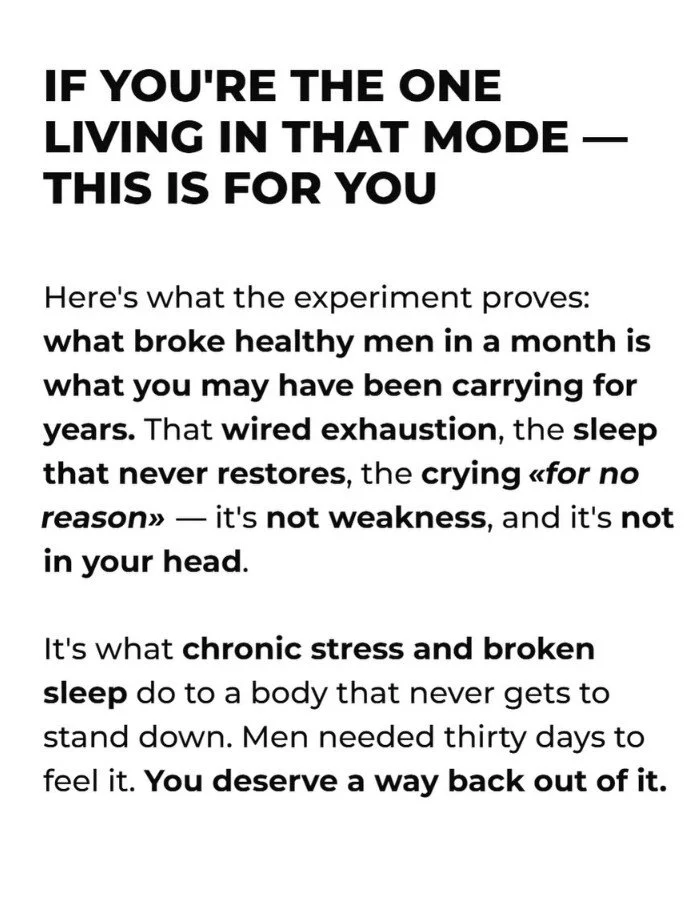
Everything that's said in slide three of the fake experiment does actually describe pretty accurately what real women are experiencing in a real household, and that's why it works. The people like me and the other mothers who read it and believed it and possibly even shared it, they're not fools. They just recognised their own lives, and wanted that acknowledgement and recognition from their friends and partners. The post screamed "look, this really is very hard and we're not making it up, and this proves it." Because we believed that bit, I guess we were supposed to go on and believe the cure that they're selling (btw I have no idea what they were selling as I didn't comment, the point is the way they're selling, not what).
It really does matter that they falsified this, even if half of what they're saying is true, because it gives men an excuse to simply dismiss women's complaints. They'll use this as an example, saying "well, that experiment didn't happen so it doesn't happen to you". All that does is further minimise women's real experiences. Women already struggle to be heard and seen and are readily dismissed in our society, whether that be in real life, online, at work, at home, when they're out, by the police, by the medical profession, etc.
Looking at the real numbers, the ONS time diaries in autumn 2023 tell us that women spend three hours 37 minutes a day on unpaid work, which includes things like housework, caring for neighbours or relatives or children, and volunteering, whereas men only spend two hours 43 minutes [3]. So on average, that's every single woman spending 54 minutes more every day of the year. Six hours a week, three days a month, and it all adds up over a lifetime. The stats show that the gap is closing slowly, which is great news; it was one hour 12 minutes in 2020, but who knows what the influence of Covid was on that [3]. And yes, men do undertake more paid work, so among people with jobs, if you add up the total of both the paid and unpaid work together, it comes out pretty similar, with literally only a few minutes between them [4]. The difference is who's getting paid for their work and who isn't. The men are being paid for most of what they do, whereas the women are only being paid for their employment, and they don't see a penny for a large chunk of the other work they do. Unpaid household work was worth £1.7 trillion in 2023, which is 61% of everything the country produces in total, and guess who's doing most of it [5]?? Women.
Sleep statistics show that on paper women actually sleep slightly longer than men [6]. Burgard researched this and went through thousands of time diaries made by American parents, and found that mothers were far more likely than the fathers to have their sleep broken to look after someone else [6]. They were the ones getting up, interrupted all through the night. Eight hours might be the same for men and women, however interrupted and uninterrupted sleep are very different things, and men get more leisure time across every stage of life [6]. A mother has so many years and years of interrupted sleep and broken nights, and there isn't a study for what that's doing to her physically. The closest thing that I could look at was a study on night shift work, which classified it as "probably carcinogenic". That was the World Health Organization's cancer agency in 2019, and they based the result on evidence in animal populations and also limited evidence in people [7]. Unfortunately mums don't have an employer, so they're not getting days off to recover, they're not being paid a penny for all this exceptionally hard work and they certainly don't get paid overtime. What they're faced with is a society that tells them to suck it up and get on with it. They just have to pay the price, mentally and physically, and according to the World Health Organization, that is probably carcinogenic.
Even more interesting is a study done by Daminger in 2019 [8]. You've probably heard the phrase "the mental load", and these are the four jobs that make that up: anticipating, working out options, deciding things, and checking that stuff actually got done. In all four of those categories women do more of everything, and the bits that fell to women the most were the jobs of anticipating what had to be done and checking that it had actually been done [8]. A study was also carried out with 322 mothers by the University of Southern California in 2024, which involved thirty household tasks being tracked, and it showed that the "thinking" bit of every task fell far more to the mother than the "doing" bit [9]. The mums that were carrying more of this mental load in the study also reported more depression, more stress and more burnout. And really, is it any wonder? These mothers are surviving on broken sleep and having to juggle a lot more mentally, pretty much from the second they give birth, whereas his life is virtually unchanged, both in terms of his pay, his sleep patterns, his leisure time and his mental load. 37 years ago Hochschild called this the second shift [10], but women have known it for eternity.
So the fake study of these "poor fathers" went viral and travelled round the globe, but real stories of real women who have been saying it for years and years barely get a few likes. The fake post even said so, that the men "knew through the body" and that "knowledge through the body works differently than knowledge through words" [1]. Yes, women have been shouting this from the rooftops for a long time, but as soon as anyone sees the post with a man saying it, they believe him. This whole fake experiment made me roll my eyes… even a fictional man is listened to more than a real woman! This has parallels to a previous blog I wrote called The Sick Years, which discusses how women are also treated differently to men in a medical setting [11].
Slide five goes on to talk about how the fictional men were talking about the hardest part being the invisibility rather than the exhaustion [1]. Women already know that they're not believed about a lot of things. One in seven women in the UK had a partner controlling their money last year, and anyone in that situation would find it far more difficult to leave a relationship if they wanted to [12]. So by earning less overall over those years, they really are penalised in terms of the freedom they may have to choose the direction of their life.
The ironic thing about this carousel is that the sales tactic they're using is to say "women, we hear you and we believe you". It seems that the only people who actually want to genuinely listen and believe women are people who want to try and sell them something. The fact that this advert is out there is a very big indicator of how screwed our current society is.
I've had three children and have suffered many years of struggling and exhaustion. I'm not complaining, I absolutely adore my family and I feel so lucky to have had children. They're all absolutely amazing, but I'm not going to say it was in any way easy or a piece of cake. I mean, every single night I went to bed and instead of saying goodnight, my husband would say to me "good luck"! This became a standing joke in our house, because what he really meant was "hope you get a good long stretch before the baby wakes you up". I was nursing, so there was no point him waking up to try and help. I vividly remember having a group of friends in similar situations, and we would laugh, because you could always text someone in the middle of the night in that group and know that you would get a response. It wasn't unusual for 3am discussions to take place, because so many of us were awake and dealing with the same thing. Endless night upon night of getting up multiple times took its toll on our family, my mental health, my physical health, my relationship.
Every mother I know, and probably every one you do, already knows all this stuff, and has nodded along going yep, yeah, yeah. But sadly, wider society needs to see a man going through the same experience and not being able to cope with it before it'll believe it.
The Receipts // (Sources)
[1] Instagram carousel, eight slides, account seva.gorobets, screenshotted 5 September 2026 (5,999 likes, 835 reposts, 4,757 shares at capture). Account profile checked 14 September 2026.
[2] "The Russian Sleep Experiment," creepypasta fiction, circulating from 2009, posted to the Creepypasta Wiki August 2010. David Mikkelson, "Was the Russian Sleep Experiment Real?", Snopes, 28 August 2013.
[3] Office for National Statistics, "Time use in the UK: 23 September to 1 October 2023," 9 November 2023.
[4] Office for National Statistics, "Time use in the UK: March 2023," 4 July 2023.
[5] Office for National Statistics, "Household Satellite Account, UK: 2023," 5 December 2025.
[6] Burgard, "The Needs of Others: Gender and Sleep Interruptions for Caregiving," Social Forces, 2011. Burgard and Ailshire, "Gender and Time for Sleep among U.S. Adults," American Sociological Review, 2013.
[7] International Agency for Research on Cancer, Monographs Volume 124, "Night shift work," 2019.
[8] Daminger, "The Cognitive Dimension of Household Labor," American Sociological Review, 2019.
[9] Aviv, Waizman, Kim, Liu, Rodsky and Saxbe, "Cognitive household labor: gender disparities and consequences for maternal mental health and wellbeing," Archives of Women's Mental Health, 2024.
[10] Hochschild with Machung, The Second Shift, Viking, 1989.
[11] With Shaking Hands, "Mostly Male Doctors. Mostly Women Patients. No Trials Since 1985," September 2026.
[12] Surviving Economic Abuse and Ipsos UK, "Measuring economic abuse," December 2024.
Sources checked 14 September 2026.