The Bill Arrives at 30
Content note: This post discusses economic abuse and domestic abuse.
In 2017 an American study looked at hundreds of children aged between five and seven [1]. The researchers asked them which of two people was really, really smart, and then asked who gets the better marks in class. The children were clear on both. The girls got the better grades, they said, and the really, really smart one was the boy.
At five the children hadn't yet picked up any difference between boys and girls. By six they had clearly been influenced by something that made them think the boys were the really, really smart ones, and it showed in how they played. When the researchers offered the six-year-olds a game for really, really smart children, the girls started avoiding it and chose the game for kids who tried really hard instead [1]. Which is super sad at just six years old.
I read that and thought about all the women who've grown up from the age of six believing that boys are cleverer than they are, because when I looked up the exam results, the girls outperform the boys pretty much every single time. In 2026 the GCSE results showed 70% of girls' entries scored a grade 4 or above, against only 64% for boys. At the top grades, 7 and above, the girls got 24% and the boys 20% [7]. At A level the boys do marginally score higher at the very top grades, and have for the past two years, but not everyone takes A levels. GCSE is the exam every child sits, and that's the one where the girls are leading the way [7]. And at university, for every 100 eighteen-year-old girls applying there were only 80 boys [7].
By the time these young adults come out of full-time education the pay gap in their twenties is tiny, 0.9% [2], so things are pretty equal in terms of pay. That six-year-old girl in the classroom who was told the boys were the smart ones grew up, aced the exams, whizzed off to university and outperformed him anyway.
Then she has a baby.
The ONS looked at the pay of women in England who had a child between 2014 and 2022 [3]. They compared the monthly pay she received a year before the birth with what she received five years after her first, second and third child. After the first child she was earning a massive 42% less, which is £1,051 a month and £65,618 over five years [3]. A second child costs her another £26,317 over the following five years, and a third a whopping £32,456 [3]. Add the three together and it comes to over £124,000. In our house that would have paid off the mortgage, which would have made a huge difference. And after she's had kids, her chance of being in paid work at all drops fifteen percentage points and stays down [3].
She doesn't have to take a pay cut. What tends to happen is that she goes part time after the first child and keeps the same hourly rate, but because she's part time she earns less overall. Dad's rate on the other hand keeps climbing, because he is still there and the promotions and pay rises keep coming to him. When the Institute for Fiscal Studies looked twelve years after her first child, men and women were 33% apart, and that's with her hourly rate never going down, purely his going up [4]. Every year she spends fully out of paid work costs her about 2% off her hourly rate when she returns, and 4% if she's a graduate, because the pay rises and promotions carried on happening while she was away, and graduates' pay climbs faster, so there's more to miss [4].
So at six she isn't losing any money, and it's the same at twenty-five, because she's quite happily outperformed him at school and university and the pay gap is pretty level. When she turns thirty, or whenever she has her first baby, the bill arrives. So what's on it? Part-time hours. Missed promotions, missed progression, and the social occasions where business often gets done. That full-time pay gap grows every decade, from 0.9% in her twenties to 3.9% in her thirties, and then it really ramps up to 9.1% in her forties and 12.5% by her fifties [2]. What changed was her circumstances. She's still the same woman, still doing a good job, it just became impossible for her to be there full time.
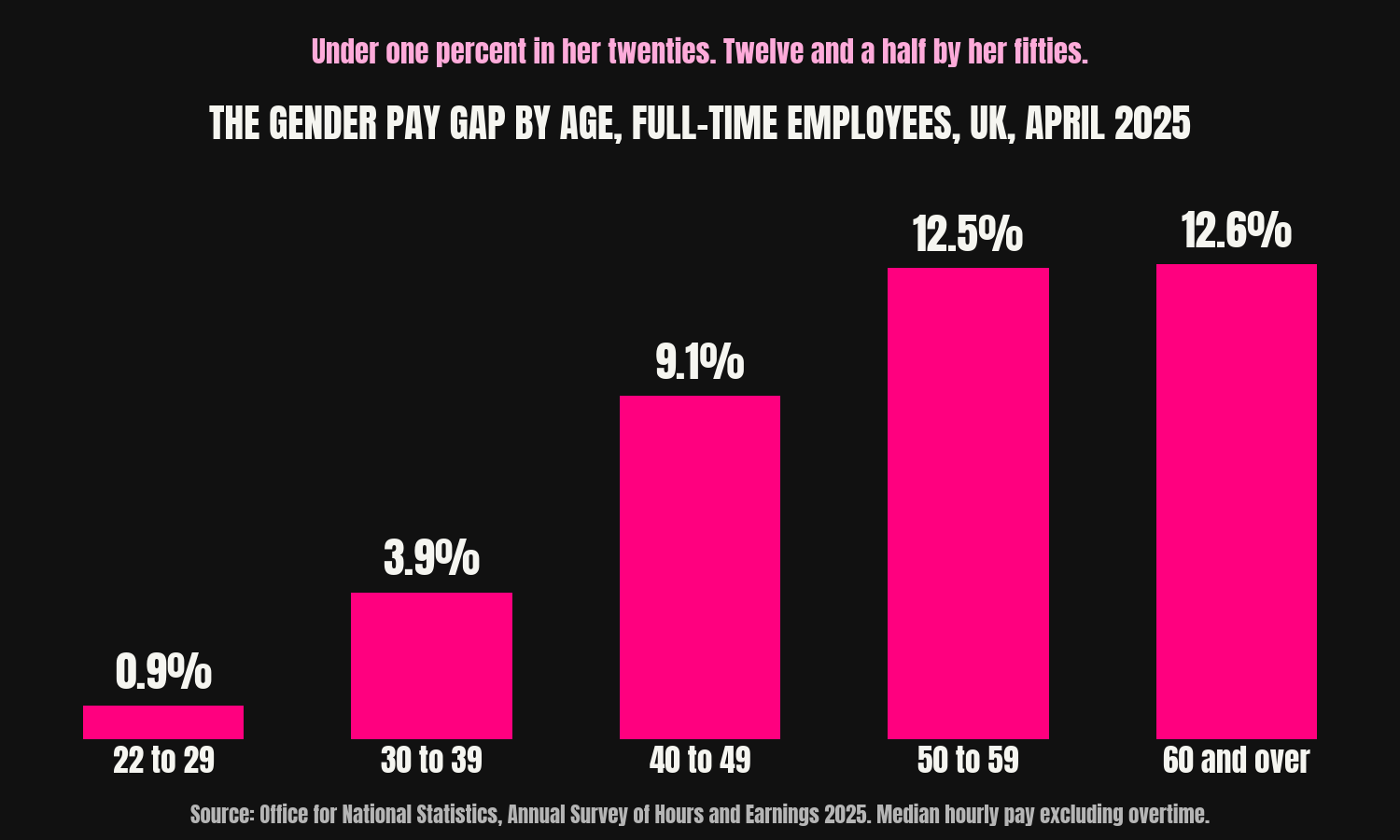
The gender pay gap for full-time workers, by age. Office for National Statistics, April 2025.
Henrik Kleven and his colleagues studied Denmark first and then six countries in total, following men's and women's earnings side by side for years [5]. The two lines travel almost identically until the first child is born, and then her line drops and never makes it back up, while his carries on flat through the birth and the years of childhood. It was the same in all six countries. The father's earnings seemed to be completely unaffected everywhere they looked [5]. The baby has two parents, and the bill goes to one of them.
I know some people are going to respond and say yeah, but it was their choice. The mother chose to go part time and take the years out, they had a chat at the kitchen table and discussed it together. And yes, I have made that decision myself. Before I even fell pregnant, when we were in the planning stages of having a family, my husband and I discussed how it would work financially. The only route that made sense for us was for me to take the time out to have the baby and nurse the baby, and then go back part time so I could be the one doing the drop-offs and pick-ups. That's still the case now they're no longer babies and toddlers, taking them to school, picking them up and getting them to the various after-school clubs and activities they do. We live semi-rurally in the Lake District and public transport isn't reliable in any way, shape or form. It's there, but the timings and locations are aimed at tourists, so getting to and from school on it would be a very difficult process for our kids. Childcare would have cost more than I was earning.
That's the problem with the choice. When couples have that discussion his pay is already a bit higher than hers, and the cost of full-time childcare is absolutely huge, a lot of the time way more than one of their wages. So when they're figuring out who should take time out to care for the baby, it makes sense for the mother to take the part-time work, especially as a lot of the part-time jobs available are in industries women already work in.
The proof is in looking at different countries. We're all human and lots of us have babies, but the system we're in determines the decision we make. The Danish mother, when she has that discussion at her kitchen table, is only paying with a fifth of her earnings, whereas a British mother is paying with 44% of hers and a German mother an enormous 61% [5]. Whether your baby is German or Danish or British, they're no more or less hard work. It's the system they're born into that determines the size of her bill.
Most single parents are women, 85% by the ONS's estimate, which is 2.7 million families [8]. She doesn't have the choice that couples may have. Her one career has to cover all the costs and fit around the school run or the nursery hours, and every time the kid is sick or needs dropping off somewhere different for a school trip, she needs to be there. So she has far fewer options for full-time work. She doesn't have the support of a partner and their income, she still loses 42% of her pay, and she's trying to cover all the house costs on her one income.
For a woman who does have a partner, her 42% less means she is more dependent on his money for the rent and childcare and the food shop, because her income alone can't cover them, and everyone in the house knows that. 4.1 million women last year had a partner or ex-partner controlling their money and what it could buy. That's one in seven [9]. Just shy of a million of them, 940,000, said it was the thing that stopped them leaving [9]. And the £65,618 she loses after the first child alone is roughly what she'd need to start again with the children: a deposit, the first month's rent, solicitor's fees etc. She doesn't have it, because she was never able to earn it.
Worryingly, one of Reform's stated policy aims is that they would like to see fewer divorces [11]. They're currently second in the polls. Imagine the price women will pay if they get in, when she already loses two fifths of her pay and nearly a million women already can't afford to leave. The future certainly looks bleaker under their rule.
As if that wasn't enough, just being a woman is enough to lose out on pay. In 2023 two sociologists studied women in Britain and Germany who didn't have any children, and how much employers were paying them [6]. They found that women who were around the right age and so potentially in a position to have a baby, were paid less than women who looked less likely, i.e. single or older women [6]. Even though she hasn't had a baby, just the sheer potential of maybe having one was enough to have her pay penalised.
So the study on the six-year-olds really was a forecast. The girls are getting the better grades but the boy is the smarter one, because the system agrees all the way through school and then takes it back the moment it matters, when she has a baby. At six it's just a game and she's steered away from it. By thirty it's more than £65,000, and it's also whether she can escape through her own front door.
I've had three children and I've had this conversation multiple times over the years, and I know how difficult it is. I know there are many women out there who have made those sacrifices to their careers because it simply makes no financial sense not to, until they look at getting back into the workforce and find it extremely difficult. I'm not sure we'd have taken a different path, but if I'd known the number, and how much it would ultimately cost over the years, at least I'd have been able to make an informed decision. I might not have had a different life, or even changed what we chose, but the conversation would certainly have been more rounded, and we'd have had more choices than we felt we had at the time. I don't want the sympathy. What I would have really liked is the stats, to show me just how much money I was likely to miss out on. These bills are paid by women, and all the evidence is right there in the statistics.
The Receipts // (Sources)
[1] Bian, Leslie and Cimpian, "Gender stereotypes about intellectual ability emerge early and influence children's interests," Science, 26 January 2017.
[2] Office for National Statistics, "Gender pay gap in the UK: 2025," 23 October 2025.
[3] Office for National Statistics, "The impact of motherhood on monthly employee earnings and employment status, England: April 2014 to December 2022," 3 October 2025.
[4] Costa Dias, Elming and Joyce, "The Gender Wage Gap," Institute for Fiscal Studies, 23 August 2016.
[5] Kleven, Landais and Søgaard, "Children and Gender Inequality: Evidence from Denmark," American Economic Journal: Applied Economics, 2019. Kleven, Landais, Posch, Steinhauer and Zweimüller, "Child Penalties across Countries: Evidence and Explanations," AEA Papers and Proceedings, 2019.
[6] Zamberlan and Barbieri, "A 'potential motherhood' penalty? A longitudinal analysis of the wage gap based on potential fertility in Germany and the United Kingdom," European Sociological Review, 2023.
[7] Joint Council for Qualifications, GCSE results, 20 August 2026. Joint Council for Qualifications, A level results, 13 August 2026. UCAS, applicant figures at the 30 June 2025 deadline.
[8] Office for National Statistics, "Families and households in the UK: 2023," 8 May 2024.
[9] Surviving Economic Abuse and Ipsos UK, "Measuring economic abuse," December 2024.
[10] Not used.
[11] Reform UK, stated policy aims on divorce, as sourced in "The Backlash Is a Receipt," receipt [2].
Sources checked 14 September 2026.