The Shrinking Season
Content note: This post discusses diet culture, weight-loss drugs and eating disorders. Support: Beat, the UK's eating disorder charity, 0808 801 0677.
Open your phone. Give it ten minutes. The thigh gap is back on your feed, the jab is discussed like skincare, and the algorithm has quietly decided you'd like to see what someone eats in a day. Everyone's noticing that thin is back. Not many are asking why now.
It isn't back. It's on schedule.
Every time women take a serious step towards power, the ideal body shrinks. It's a pattern with dates, and two writers nailed it decades ago. Susan Faludi called it the backlash: every advance women make gets answered by a cultural counterattack. [1] Naomi Wolf called it the beauty myth, and made the specific claim that runs through this whole piece: as women got more rights, the beauty standard got thinner, harder and hungrier, because it had to do the controlling that the law no longer could. [2]
When women won the vote in 1918 and 1928, the ideal silhouette of the 1920s became boyish, flat, shrunken, an about-turn from the curves worshipped a decade before. Wolf's reading: the first mass dieting craze arrived almost exactly as the ballot did. [2] Second-wave feminism crests in the sixties and seventies, and Twiggy's frame became the standard issued to every woman who'd just been issued rights. The nineties put women into universities and workplaces in record numbers, Girl Power on every screen, and fashion answered with heroin chic, an ideal literally named after sedation. Then the freshest cycle, the one we're living in: a decade of body positivity and MeToo, women visibly taking up room and refusing to apologise for it, answered by the quiet deletion of every curve campaign and the fastest-growing drug market in Britain.
Four advances. Four shrinkings. One rhythm.
And this time around, the cycle has a needle in it. Around 1.6 million adults in Britain used weight-loss drugs in a single year, and that use is twice as common among women as men. [3] Of private prescriptions, the ones people pay for out of their own pocket, 80% are taken by women. [4] The drugs don't care who takes them. The culture does, and the culture has decided, as it always decides, that it's women who need shrinking.
Why shrinking, specifically? Because a body kept small is a body kept busy. Hungry, tired, self-monitoring, counting, weighing, spending its money and its attention on itself instead of on the world. Wolf put it plainly: dieting is the most potent political sedative in women's history. [2] A woman consumed by her own body has nothing left over to consume anything else. Not the boardroom. Not the ballot. Not the street.
I can still tell you the calories in a banana. Ninety-five. I've had that number memorised for thirty years, but I never chose to learn it. I could also tell you what I weighed on my wedding day, what I weighed after each baby, which summer I lived on soup and which one I 'was good'. Thirty years of maths, running in the background of a mind that had other plans. Now multiply me. Nearly every woman is running the same programme. All that intelligence, all those hours, a whole gender's worth of brainpower, spent counting almonds instead of running the world. That's not a beauty standard. That's a robbery. The longest-running heist in history, and I want it back.
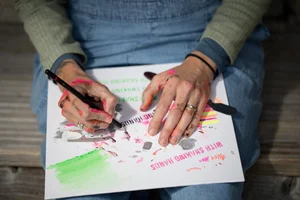
I have a fair idea of where the instructions came from, because I've spent these past few weeks tearing them out of a dictionary for a new piece called Still Make Fists. The words women were told to be: demure, modest, docile, meek. Every one an instruction, and every instruction the same instruction. Take up less room. The diet industry is those torn pages made flesh. The command moved off the page and onto the body, and then it charged us for the privilege. Still Make Fists is on the easel now, one half of a pair, The Shrinking Season the other. Neither is finished. This blog couldn't wait for them, but when they're done, you'll be the first to see.
Let's also not forget that someone is getting paid for this. The shrinking season isn't a preference, it's a product with a sales cycle, and the sales cycle is timed to our progress. The global market for these drugs is forecast to reach around $150 billion by 2030. [5] The standard isn't handed down from heaven. It's manufactured, marketed, and now injected, and every cycle of backlash is a revenue forecast somewhere.
And the bill lands on our girls before they've done anything but grow. In 2009, 72% of girls aged 7 to 21 were happy with how they looked. By 2023 it had dropped to 59%. In the same survey, 68% of girls aged 11 to 21 said they'd like to lose weight, and over half had dieted or skipped meals to do it. [6] Children. Skipping meals. And the machine makes sure of it: researchers set up TikTok accounts posing as 13-year-old girls and the algorithm served eating disorder content within eight minutes of joining, with body image content pushed every 39 seconds, and accounts that hinted at wanting to lose weight got hit with harmful content every 27 seconds. [7] EIGHT minutes. My daughter can't find her shoes in eight minutes. The algorithm can find her insecurities before she can name them. Hospital admissions of young people for eating disorders in England rose 514.6% in a decade. [8] That's not a trend. That's an invoice, and girls are paying it with their bodies.
So where does that leave us? Not with ‘love yourself’. I know that's a common fight-back phrase, and I'm sorry, but look at who's selling it… The same industry that spent a century telling women they weren't enough now has a ‘self-love’ range. Love yourself, buy the serum. Love yourself, book the treatment. Love yourself, and there's a jab if you're still not there. It's the old instruction in a kinder voice, because a woman who genuinely believed she was fine as she is would have nothing left to buy.
There is, however, a strange, furious hope buried in all of this: the shrinking season is a compliment. If the ideal shrinks every time women gain ground, then the season currently flooding your feed is proof of the ground we've gained. They don't sedate people who aren't a threat. Nobody builds a $150 billion machine to quieten women who were already quiet. The backlash only ever arrives after the advance. So the jabs, the thigh gaps, the what-I-eat-in-a-days: read them as the panic they are. We got too loud, too visible, too big, and the machine reached for its oldest trick.
It won't work on a woman who can see it. So see it. Eat. Take up the room. Keep the hunger and the hours and the money they're counting on, and spend every one of them on the world instead. I tore "demure" out of a dictionary these past few weeks, along with modest, docile and meek, and then I opened my phone and found the same instruction printed across the whole culture, waiting for my daughter. The most political thing a woman's body can do this year is stay exactly the size it is. Take up less room? No. Take up more.
## Receipts
[1] The backlash: every historical advance by women met by a cultural counterreaction. Source: Susan Faludi, Backlash: The Undeclared War Against American Women, 1991.
[2] The beauty myth: as women gained legal and material rights, images of female beauty grew thinner and more punishing, taking over the work of social control; dieting as "the most potent political sedative in women's history"; the emergence of mass dieting culture alongside women's suffrage in the 1920s. Source: Naomi Wolf, The Beauty Myth, 1990. The historical pattern is presented here as Wolf's documented argument.
[3] An estimated 1.6 million adults in England, Wales and Scotland used weight-loss drugs (Mounjaro, Wegovy, Ozempic, Rybelsus, Saxenda) in the year to early 2025, with use twice as common among women as men. Source: UCL study, BMC Medicine, published January 2026.
[4] Almost 80% of private prescriptions for weight-loss drugs go to women, based on analysis of 113,630 patient prescriptions between November 2024 and October 2025. Source: The Health Foundation with Voy, 2025.
[5] The global GLP-1 weight-loss drug market forecast to reach an estimated $150 billion by 2030. Source: PwC market analysis, reported 2025. Verify the precise figure on the day of publication; forecasts move.
[6] Happiness with appearance among girls aged 7 to 21 fell from 72% in 2009 to 59% in 2023; 68% of girls aged 11 to 21 would like to lose weight; 53% have dieted or skipped a meal to lose weight. Source: Girlguiding Girls' Attitudes Survey, 2023.
[7] TikTok accounts registered as 13-year-old girls were served eating disorder content within 8 minutes of joining, body image and mental health content every 39 seconds, and, for accounts signalling a desire to lose weight, harmful content every 27 seconds. Source: Center for Countering Digital Hate, Deadly by Design, December 2022.
[8] Hospital admissions of young people for eating disorders in England rose 514.6% between 2012 and 2022. Source: The Lancet Child & Adolescent Health, 2025 (study of admissions among 5 to 18 year olds, reported January 2025).
Sources checked at time of writing. Figures and reports current as of July 2026.