The Dial, part two
Content note: this blog is about rape and partner violence, including sexual violence in war.
I decided it was time to look back at a previous blog post that I wrote called The Dial, because the topic had been popular on my Instagram reels, and raised valid questions. The blog’s main message was that inequality and hierarchy drive male violence against women and that there are some societies that have no rape and almost no male violence. This does sound like a pretty amazing place, and it garnered a lot of attention. In fact loads of people commented. I think a lot, particularly women, felt hope that there could be something we could learn and implement here and a lot of others, mostly men, simply didn’t believe it and asked for examples. I had detailed my findings in the blog, but a lot of the time people only watched a 30 second reel. Others claimed that it was impossible because “it’s just nature” and “men are built like that”. There was a much smaller group of people who did some research and came with footnotes, citing a 1989 paper, a criminology textbook and a meta analysis and they felt that the research didn’t hold up to scrutiny. So I decided to go back, look at it again, do some deeper research and see if I could address the most common questions in more detail. And sincerely, I have the people who questioned me to thank for being able to make this piece even better. We absolutely need to try and have adult dialogues, learning more about things as we go, being open minded to new information (in both directions) rather than being pitted against one another, making up stuff and slinging insults. Let’s all share the information we have kindly!
So to reiterate, what I found (or thought I found) was not that men were evil, because I really don’t think they are. But that the amount of male violence against women and girls is set by the society that surrounds it and therefore, anything that has been set, can be reset. That’s it, the whole blog in one line. The rest of this blog will show how I came to that conclusion, with as many receipts for the evidence as I can find.
Let’s start with the Gerai. And a quick note, I’d like to tell it as a story because that is how it was told to the anthropologist who recorded it. There is a Dayak community (indigenous, non-Muslim people, native to Borneo) of about 700 people called Gerai in Indonesian Borneo, and in the late 1980s there was a woman called Christine Helliwell who was living there alongside them [3]. Now just before I begin, I know what you’re thinking, seven hundred people in a rainforest isn’t Britain, but hold that thought because the big numbers come a bit later. I’m purposely starting small because they’re where someone actually lived alongside people and watched with their own eyes. And I also want to address the fact that some commenters on my previous blog thought these people were ‘backwards’. Well the Gerai were farming rice and trading in the 1980s, not living in the Stone Age, so please bear in mind that just because someone is speaking another language and doing things in a different way to you doesn’t make them backwards, wrong or lesser.
So, the story… one night a woman woke up in the middle of the night to find a man inside her mosquito net, gripping her by the shoulders and climbing in. She awoke startled and shoved him really hard, so hard that he fell backwards, ended up getting all tangled in the netting and finally managed to scramble away across the floor and out [3]. The next morning word had spread around the village and everyone was laughing at him. One of the older women in the community, a friend of Helliwell’s, said “No, not bad, simply stupid” [3].
At this point Helliwell was trying to understand exactly what had happened, and was repeating back the story to the woman. But she couldn’t find a local word for rape, so she tried explaining it by saying “he was trying to have sex with you when you didn’t want to, he was trying to hurt you?” And the woman looked quizzically at her and said “Tin, it’s only a penis. How can a penis hurt anyone?” [3] (Tin was their name for Christine.) The Gerai woman simply couldn’t understand the question because in her community, rape wasn’t a thing.
The Gerai people didn’t see men and women as fundamentally different. They have a “belief in the biological sameness of women and men” [3]. One of the women told her, “We all must nurture because we all need” [3]. Men’s work and women’s work did exist, but there wasn’t a rigid split; either could and did do the other’s jobs [3]. Helliwell spent time with this community and her studies disproved the widespread assumption that “rape is universal”.
Of course this is just one anthropologist in one village. And Gerai men were seen as braver and held higher status in some ways [3]. However women didn’t fear rape, they were more afraid of a witch’s curse [3]. It wasn’t paradise, but importantly it was a place where a man’s body wasn’t thought capable of overpowering a woman’s, and so it didn’t. This is about power.
Here’s another example, from a different anthropologist, from a different part of the world, but with very similar findings. Vanatinai is the largest island of the Louisiade Archipelago off the eastern tip of Papua New Guinea. It’s a beautiful tropical land, mountainous and covered in rainforests, with reefs surrounding it. In 1987 its population stood at around 2,300 people and Maria Lepowsky lived there for two years from 1977 and went back twice over the next decade, in 1981 and 1987 [4].
She said that she “heard of no cases, past or present, of rape. Wife beating is rare and is strongly disapproved of” [4]. She explained it by showing that the people of Vanatinai had “no ideology of male superiority” and that there was “no male coercive power or formal authority over women” [4].
Just like the Gerai people, things weren’t all rosy. And Lepowsky reported as such, saying “Vanatinai is not a perfectly egalitarian society” [4], but violence of any kind was rare and condemned. So rare in fact that in the ten years she studied them, there were only five fights, and women started four of them! [5].
These two examples don’t prove the world can change, but they do prove the same thing was found twice. They prove that it is possible for a group of human beings to live together without rape, which is the thing I was told in the comments was impossible. It isn’t just “human nature”. Whether it scales up to bigger societies is the next question, and there’s also a lot of research on that which I dived into.
The study that I wrote about in a previous blog, The Dial, was done by Peggy Reeves Sanday in 1981. She started with a sample of 156 societies, but when she looked at them, 61 of the anthropologists’ reports simply said nothing at all about rape, either way, so there was nothing in those for her to code. This left her with the remaining 95 which had useable information on rape, and so were the ones she studied [1].
The sample didn’t allow for cherry-picking. It’s the Standard Cross-Cultural Sample, which was drawn up by two other anthropologists, Murdock and White in 1969, twelve years before her study. What this did was to divide the world into 186 culture areas, and pick one society to stand for each area. No two societies on the list are close relatives, and every part of the world is in it across six regions: sub-Saharan Africa, the Mediterranean and Middle East, Eurasia, the Pacific Islands, North America and South America [1]. The world really is an enormous and wonderful place with such a huge diversity of cultures.
Yes, this list is from way back in 1969, and yes, the reports it uses are older still. No one is suggesting that we should go and live like them, the point is that we, as a human society have lived without rape as a normal part of life. Plenty of places did or do and it was written down, at the time, by people who lived there.
Of the 95, 45 of them, just under half, were what she called rape-free (47%). There were 33 societies that were in the middle (35%) and 17 that were rape-prone (18%) [1]. Now to be crystal clear, when she said rape-free she didn’t mean completely absent. She defined it as “either infrequent or does not occur”; the coding was “rare or absent” [1]. By contrast the definition of the rape-prone category was “common, or ceremonial, or used by men to punish and threaten women” [1].
So she wasn’t trying to pretend that some societies were completely rape-free. She never meant zero, and she clearly said this in her paper in 1981 and again in 1996. She said she used the term “not to suggest that rape was entirely absent” but to mean that any form of sexual aggression was severely disapproved of and punished to the full extent. She also said that “there may be some men in all societies who might be potential rapists” [2]. She was looking for trends as to what these societies had in common versus the rape-prone ones.
What did she find that had the biggest impact? How violent men were to each other. This was the strongest link in the whole study, and it showed that the more violent men were, the more rape there was. But also an increased ideology of male toughness, more women being shut out of public decisions and holding less authority in all regards, increased raids on neighbouring villages to take their women for wives and more war, all equated to more rape [1]. And how sexually strict the society was made no difference at all, as she said that “there is no significant correlation between variables measuring sexual repression and the incidence of rape” [1]. So just because men aren’t getting any doesn’t mean they’re out forcing it on others. That can’t be used as an excuse. And three objectors on the reel said that the women in those societies ‘probably dress properly’ or ‘were modest’. So covering women up won’t do anything to stop rape, men being raised not to be violent would though.
In my previous blog I said that rape-free societies had men doing the care work. And I need to clarify this. What Sanday actually measured was how close fathers were to their babies and, as you might imagine, it went the way you think: closer fathers = less rape. But it was too small a difference to pass the standard statistical test, so by the rules of her own paper it didn’t count as a finding because it could just be chance [1]. However, the things that did pass the test were: boys not being raised to be ‘hard’ and including women in the decisions. When these things happened, rape was less frequent.
Examples that Sanday included in her 1981 paper, which all quoted the anthropologists who lived there include:
The Mbuti, hunter-gatherers of the Ituri rainforest, numbering in the tens of thousands, in what is now known as the Democratic Republic of Congo (DRC), where a man “may never have intercourse with her without her permission”.
The Tuareg, nomad desert people, numbering in the millions, of the Sahara across Niger, Mali and Algeria, where “rape doesn’t exist, and when a woman refuses a man, he never insists”.
The Ashanti of Ghana, where there was one case recorded and the man “was condemned to death”.
She does caution that “The above quotes may obscure the actual incidence of rape” [1]. But her conclusion from the study was that “Rape is not an integral part of male nature, but the means by which men programmed for violence express their sexual selves” [1].
Now someone here is going to raise the issue of the widespread rapes of women and girls currently in the DRC. And this proves the point. The Mbuti report that Sanday quoted was by Colin Turnbull who was the anthropologist who lived with them in the 1950s. Since the late 1990s eastern Congo, including the Ituri, has been at war and armed groups have used rape, looting and killings as weapons [41]. So the same people, sixty years apart: when at peace rape was almost unknown and a man needed a woman’s permission, but as soon as violent armed men arrived, the dial turned and rape became a weapon. And that is exactly what Sanday said.
In 1989 David Levinson looked at violence inside the family in 90 small-scale societies [6]. He found that wife beating “occurs at least occasionally in 84.5% of the societies” in his sample and frighteningly it occurs in virtually all households in 18.8% of them [6]. Beatings bad enough to actually kill someone or permanently injure them show up in 46.6% [6]. So yes, those that say violence is nearly everywhere are right. Having seen this I concede that.
But then I looked deeper at the sixteen societies in his sample that had no or rare family violence, and they spanned all seven regions of the world: the Iroquois, the Ona of Tierra del Fuego, the Ifugao of the Philippines, the San of southern Africa, the Central Thai, the Libyan Bedouin, the Andaman Islanders, the Sami, the Kurds, the Javanese and others [6].
He found that in those societies women kept what they earned, people made decisions together and a woman was free to divorce or leave the partnership. Also there was lower family violence when relatives or neighbours stepped in straight away, which broke it up before it got worse [6]. Makes sense, right? We all, especially young people, need guidance, and if it’s not there, the violence escalates.
I’ve been lucky, growing up in a house with no violence in it. I had parents who guided us without hesitation and we had a community of family and friends who looked after each other. I didn’t realise just how lucky we were until I’d grown up and discovered that not everyone has that.
So the bit that was missing from The Dial was the bigger and more recent societies. Although villages from the 1980s delivered important and relevant information, let’s face it, they were done 40+ years ago. The information I’ve since found includes some of the biggest surveys ever done, and asked women the same questions in many different places. Every single one of them finds that the rate varies several times over, that can’t just be chance.
First, the World Health Organisation (WHO) published a study in The Lancet in 2006. It asked 24,097 women across 15 different sites in ten countries the same questions and the authors concluded that violence is not inevitable and must be addressed. Lifetime partner violence (physical or sexual) had a huge range, from 15% in Yokohama to 71% in rural Ethiopia [7]. The stat that leapt off the page was that in 14 of the 15 places studied, women were in far more danger from their partner than from anyone else [7]. This ties nicely into another blog I wrote called Treat Women Like Shit and They’re Not Going To Have Your Babies. If women are being treated badly surely it makes sense that the birth rate will decline. But that’s another story.
Even more recently, in 2022 The Lancet again published a WHO study which covered almost the whole world. 161 countries, 366 studies and approximately two million women. Overall worldwide results found that 27% of women who had partners had experienced partner violence in their lifetime. That’s just over 1 in 4 women. And the variance was big, with Central Europe at 16% and Oceania with 49% [8]. More recently still, in 2025, the WHO’s newest figures show that in the past year alone partner violence was experienced by 5% of women in Europe and North America and 38% in the Pacific Islands. This is a sevenfold variance in the same year, with exactly the same questions [9]. Something is causing this variance and the WHO explained it: “Gender inequality is a root cause of violence against women and girls” [10].
And yes, the 5% figure above is right. I had to triple check it myself, and it’s the number that surprises most people. It’s taken from the WHO’s November 2025 figures for the past twelve months and is the lowest of any UN region. The worldwide average was 11% across 316 million women [9]. Note that this is partner violence, not all violence against women and the lowest in the world doesn’t mean it’s low or non-existent. One woman in twenty in a year is still millions.
But WHY? In 2015 a study by Heise and Kotsadam did 66 surveys in 44 countries, totalling almost half a million women and found very similar results to Levinson’s and Sanday’s. Thirty years and half a million women apart, but came to the same conclusion. What predicted the country’s rate was “norms justifying wife beating”, “norms related to male authority over female behaviour” and also whether the law let women own land and property [11]. The wealth of a country didn’t make a difference to the rate. So a rich country is only safer when its men have stopped thinking that they’re allowed to do it. Which, with huge cut backs in public services and overcrowded prisons, doesn’t bode well for any immediate improvement here in the UK. A separate American study clearly showed that American states that reported more gender inequality also reported more rape [35].
Part of me wondered, when I started this, if the problems we see in our society today were simply due to the fact that we’ve grown too big to know each other. Partly, maybe. The researchers had their own thoughts on this. Sanday’s view from her 1981 book is that male dominance isn’t simply part of being a man, but appears when a society comes under stress from things like food shortages, migration and outsiders. She also says that this all came ‘relatively late in human history’ [31]. Lepowsky says that the rarity of men attacking women is a characteristic of societies which value equality, i.e. egalitarian and not of small ones [5]. Levinson’s sixteen low-violence societies included the Central Thai and the Javanese, both of which are big peasant societies, not little communities [6]. And some of the lowest rates of partner violence in the world today are in Europe and North America, and the highest aren’t (49% Oceania, 44% central Africa) [8, 9], so it’s what a society lets men get away with rather than size alone that explains it.
A lot of men in my comments said that these societies didn’t last or that they lived in grass huts and never built anything. Looking back to where peaceful societies have gone, it’s mostly because more violent ones came and conquered them. So violence is very good at taking land, but it doesn’t make it a better way to live, well certainly not for women and probably not for the men either. The places with the lowest rates of partner violence today, according to the WHO, are some of the most complex societies on earth [9], hardly primitive as implied.
Sanday didn’t stop after she’d researched the 95 societies. From 1981 she went back to West Sumatra almost every year until 1999, and she lived with the Minangkabau. They are the largest matrilineal society in the world, numbering about four million in their home province. They are mostly Muslim, have modern cities and universities, inside the fourth most populous country in the world [32, 47]. Matrilineal isn’t to be confused with matriarchy. In a matrilineal society land and the family home pass from mother to daughter and the husbands move into the wife’s home. The people are proud to call themselves a matriarchaat [32]. Women do not ‘rule’, the clan heads and the mother’s brother hold the formal positions while women hold the property. And that’s exactly what makes it work, because it’s flat rather than hierarchical.
The local people told Sanday that rape was virtually impossible because custom, law and religion forbade it and she herself, in the village where she lived, only heard of two cases of rape in all her years there. She did also record that some argue that they aren’t rape-free in Padang, the provincial capital [2]. So this example shows a modern society of millions, not a village from 40+ years ago, showing exactly the same pattern.
The good news: if the rate is set by society, which I feel has been clearly demonstrated by the studies I’ve explained above, then it should be possible to change it. And, it has been shown to shift in three ways. First: a fully randomised trial, published in 2020, with about 1,650 couples over 21 sessions in rural Rwanda [12]. Two years later and women’s past-year violence from their partner was down 56% compared to the couples who didn’t participate, plus the men’s own reports of doing it were 46% lower [12]. So if you’re a man arguing that it’s just human nature and can’t be helped, this study says the opposite. Yes, it can be helped, because it was taught and it was untaught in two years. So that’s no excuse.
Second: attitudes over time have changed. A study of nearly two million women across 69 countries, with repeat surveys between 1999 and 2024 reported that acceptance of a husband hitting his wife fell in 94% of them. Not only that, in the countries where it fell faster, the violence also fell faster [16]. That is significant proof. The Lancet did its own review of more than a hundred evaluations and found that “it is possible to prevent violence against women and girls” [38]. So yeah, it’s definitely a dial.
Third: our own country. In England and Wales, the share of women who’d experienced domestic abuse in the last year fell from 11.1% in 2005 to 8.1% in 2020, thanks to a drop in partner abuse [14, 15]. I am aware that these figures are a few years old, but the ONS changed the questions in 2024 and so the new numbers can’t be compared to the older ones. New comparisons can begin from the 2024 data onwards.
Great news, but sadly also not so great. In November 2025 the WHO said that progress on partner violence has been “painfully slow”, with just a 0.2% fall a year, and that it had “barely changed since 2000” [9]. The world isn’t fixed, far from it, but we do at least now know what the problem is, even if a lot of people won’t accept it or work to change it. And we also know that the places where the trials happened DID change the norm and DID reduce partner violence. It can be done.
My previous blog and the associated social media videos and reels that went with it got a lot of comments and I would like to address some of those here. I’m more than happy to change my mind if evidence shows that to be the case, so here are the eight objections that came up most across 1.18 million views and 961 comments.
Palmer: the rape-free societies weren’t rape-free
A 1989 paper by Craig Palmer was cited as proof that societies that had been called rape-free actually weren’t. He went back through 31 societies, including some of Sanday’s, and found that there had been incidences of rape reported in them. He concluded that rape is “present in all societies despite efforts to restrain men from it” [17].
Yes, Sanday did code what anthropologists wrote, and no she didn’t count cases, and she says this in her report [1]. She wasn’t hiding anything. She never claimed it was zero anywhere. Her coding was “rare or absent” and she commented in 1996 that it was “not to suggest that rape was entirely absent” [2].
The commenter conveniently failed to note that Palmer’s own abstract says his results “do not mean that rape cannot be eradicated through social change” [17]. And I’d say that bit’s pretty important, wouldn’t you?
So it turns out that the man they cited against me actually agrees with me on the real thing that matters: rape turns up everywhere, and that it’s set by the society.
It just wasn’t reported, or it wasn’t called rape
A lot of people commented along the lines of “of course it looked rape-free, nobody reported it, or they didn’t call it rape”. And yes, Sanday said exactly this herself, she didn’t try and hide it. She said that the anthropologists’ quotes “may obscure the actual incidence of rape” [1], and Palmer went looking and did find reports in some of them [17]. Nobody is specifically claiming a count.
Firstly, the Gerai story from the beginning of this blog found the opposite of hiding it. The woman pushed him out, told everyone and the entire village laughed at him in the morning [3]. She knew exactly what he was trying to do and she simply couldn’t imagine it succeeding. A society that is trying to cover up rape or a society under-reporting wouldn’t act like that. Secondly, the modern numbers come from surveys rather than police reports, asking the women themselves, in private, with the same questions in every single country [7, 8]. Thirdly, as researchers have explained in the Nordic paradox [28], under-reporting actually works the other way round. Where women feel safe to speak, they disclose more.
Regardless of arguing over whether any given village had zero rapes or two, what Sanday found was a reliable pattern across 95 societies. It showed that where rape was rare, men were also less violent to each other and women got included on decisions [1].
One line from Sanday’s paper got quoted back to me a few times. In 1921, when asked what the punishment for rape was by a traveller in Mongolia, the local lama said “We have no crimes of this nature here. Our women never resist.” Sanday printed that in her paper, and that society went down as rape-free partly on the strength of it [1]. I know, slightly mad right? And that was in 1921, over a hundred years ago, from one traveller passing through, which is just about as thin as evidence can get. She included it with a caveat that said, in the very next paragraph, quotes like that “may obscure the actual incidence of rape” [1]. That lama’s village doesn’t make the pattern and it doesn’t break it, it’s what we commonly call ‘anecdotal’.
A lot of people pointed out that forced sex inside marriage wouldn’t have been called rape in any of these societies. That’s true, and it wasn’t called rape here either. In England a husband couldn’t be convicted of raping his wife until 1991. Sanday didn’t separate forced sex inside marriage from outside of it, because almost nobody did when those records were written [1]. So the undercount is consistent across all 95 of the societies, the rape-prone ones included, and it doesn’t change which came out where.
It’s biology, it’s evolution
Several of the comments took the general line that rape is evolved, and that men are just built for it, it’s in their “biological make-up”. One quoted a paragraph from a criminology textbook saying that socialisation theory lacks evidence. However the chapter in question is explaining why men offend more than women [39], which is an entirely different question. Having a difference between the sexes can’t explain the huge seven-fold difference in partner violence between regions among men.
Thornhill and Palmer wrote a book, A Natural History of Rape: Biological Bases of Sexual Coercion, in 2000 [18], which is probably the strongest evolutionary case, and in a reply to critics in 2003 they wrote that either of their theories “predict that the frequency of rape will fluctuate with environmental, including social and cultural, variables” [18]. Their publisher even commented, saying that “the authors do not view it as inevitable” [18]. So even the people who are arguing that rape is an evolutionary adaptation go on to say, in writing and on the record, that the rate is set by the society!
Another evolutionary biologist, Barbara Smuts, said in 1992 that “In some societies male aggressive coercion of women is very rare” [19]. She explained that it was more common in places where women’s alliances are weak, where women have no kin to back them, where male alliances matter most and where men control resources [19]. This is all starting to sound familiar, isn’t it? Very much like Heise and Kotsadam, Levinson and Sanday! She also went on to say that none of that “implies that male domination of women is genetically determined” [19]. So the argument that I’ve been trying to make has just been made by an evolutionary biologist. I’ll take that as a win.
Other comments mentioned that it’s to do with testosterone. However when I looked this up I found that the biggest review of the human research found the link between a man’s baseline testosterone and aggression was tiny, a correlation of just 0.05. The experiments showed even weaker results. When researchers gave people testosterone and then measured their aggression they found no effect, well, in technical terms it was “weaker yet, and not statistically significant” [20]. Someone better tell Pete Hegseth… Sapolsky said that “Testosterone did not create new social patterns of aggression; it exaggerated preexisting ones” [44].
Inequality and crime is weak, one of the least replicable theories in criminology
OK I’m happy to concede part of this one. The latest meta-analysis, done by Pazzona in 2024, looked at 1,341 estimates from 43 different studies and although it found inequality’s effect on crime overall was “statistically significant”, it was “economically insignificant”. This means the link is real, but even reducing inequality a lot would barely move the overall crime rate [21]. So therefore it’s a fair objection, for crime in general.
Homicide however is covered in separate literature and it should’ve been included in The Dial, so my mistake there. In 1993 Hsieh and Pugh looked at 34 studies and found 76 correlations between poverty or inequality and violent crime (murder, assault, rape and robbery), and 74 of them were positive [22].
In 2011, Nivette undertook a meta-analysis of what predicts murder rates across countries and they found income inequality among the strongest factors, but the overall wealth of the country to be one of the weakest [23]. Yet another study found the same: Daly, Wilson and Vasdev in 2001 looked at both Canadian provinces and American states and found that inequality was “a stronger determinant of levels of lethal violence in modern nation states than was the average level of material welfare” [24].
The World Bank also said in 2002 that the link between inequality and homicide “reflects causation from inequality to crime rates” [25].
Martin Daly wrote an entire book on it in 2016, Killing the Competition: Economic Inequality and Homicide, and as he puts it himself, summing the book up, “income inequality is the best predictor of the local homicide rate” and “most homicides are the denouements of competitive interactions between men” [37]. So yeah, inequality and humiliation keep coming back repeatedly as the answer here.
If you’ve read or heard about The Spirit Level, the 2009 book that made the inequality argument famous, you’ll know the chart of 23 rich countries, inequality along the bottom, murder up the side and a straight line through them. A critic pointed out in 2010 that the line would look very different if it weren’t for the United States, which is far more unequal and far more murderous than any other rich country, hardly a surprise given how many guns they have. If you take America out, then the line virtually disappears. So he’s right, and with this new information I’ll happily give up the chart because it’s not needed. Thirty-four studies, another meta-analysis, a book, and the World Bank all say the same thing without it [23, 27].
Latin America and time preference
A 2023 study by Schargrodsky and Freira looked at homicide rather than any other crime because it’s the least under-reported. It can therefore be used for more reliable comparability between countries. It used two databases and two surveys and found that as the rich get richer and the poor get poorer, the male-to-female homicide ratio grows. The women aren’t spared, but the gap between men killed and women killed gets bigger, with men on the losing side. Which takes us back again to Daly’s point that inequality sets men competing with each other which results in more homicides.
One commenter said the real cause in Latin America is time preference, which is economist-speak for people who can’t wait for the reward and want it now rather than later. The study he was quoting followed Swedish thirteen-year-olds who were offered money now or more money later and found that the impatient ones were more likely to end up with criminal convictions. That’s definitely interesting, but it’s only about individuals in one country, and the authors themselves call it a ‘first’ piece of evidence [46]. It doesn’t say anything about why the homicide rate is higher in some countries and lower in others.
Nobody raised it, so I will: the Nordic paradox
Perhaps you’ve heard of the Nordic paradox, but if not, it shows that the most gender-equal countries in Europe report the most partner violence. An EU-wide survey published in 2014 showed Denmark topping the table at 32%, followed by Finland at 30% and Sweden at 28%. Against an EU average of 22% and Spain at the lowest 13% [28].
The first possible explanation is that equality allows more people to come forward and disclose abuse, and that where violence is kept private, women tell surveys less [28]. A study done in 2021 found that the paradox “disappears” when individual and country factors are considered, and that it “cannot be understood independently from a wider pattern of violence in society” [30].
At the end of the day, equality indexes count the number of women in parliament and measure the pay gap. The partner violence figures come from the women themselves, with the same surveys being used in every country. What Heise and Kotsadam found is that a country’s figure goes up and down with what people there say they believe about whether a man may hit or control his wife, and with whether women can own property, and it doesn’t follow how many women sit in its parliament [11]. So the Nordic figures are women speaking, and Swedish women say it more, but nobody has shown that Swedish men hit more.
So I can’t say the Nordic paradox has been debunked, even the experts can’t fully explain it, but nothing in it contradicts what I’ve argued here.
It’s immigrants, it’s Africa, they’re white societies
Sadly, there were a lot of racist comments on my social media reels when I covered this topic. Some people decided, not just in their heads, but brazenly typed out onto my content, that it was immigrants. Others said it was Africans, Jews, Muslims and others said that it was white societies. The insults came from all sides, and none of them are true, because the truth is that Sanday found rape-prone and rape-free societies in every region of the world [1]. The two villages that I talked about in this blog were in Borneo and Papua New Guinea, so the people who told me the rape-free societies were white societies had got that wrong, and clearly they’d not read the blog, and probably won’t read this one. According to the WHO surveys, the lowest rates of partner violence are in Europe and North America and the highest are in the Pacific Islands [9]. This is about the conditions I have been describing all the way through this blog, and skin colour doesn’t come into it anywhere. It’s not difficult to get this: rapists should get the same punishment and their victims the same protection whoever they are, wherever they were born, whatever colour their skin is and whatever god they may or may not pray to. The way that people talk about this is incredibly frustrating because as soon as people start trying to break down which particular group of men it is, the girls are being used as ammunition for a particular cause or belief. That is taking advantage of them as victims and is abhorrently wrong, so please just stop.
Women are violent too
The last objection to my blog, which was under every reel I posted that week is: women are violent too, CCTV proves it, lesbians fight, queens, ‘now do female violence’. Nobody anywhere is saying that women can’t be violent, and of course there are times where this happens, but just look at the numbers to see that it’s not even close. In England and Wales 98% of people who report rape or assault by penetration say it was a man [42]. Globally about nine in ten people who kill are men [43]. This blog is about the violence that makes up nine tenths of the problem, and I promise that if the other tenth becomes a bigger number I will write about that too. If it was 90% of anything else, we’d call that pretty good odds as to the cause, and I don’t see why men should be any different.
The same things keep coming up time and time again and so to summarise everything that I’ve written about in The Dial and this blog, below is a table that shows the five different sets of research, measuring different things, and what conditions they found. The overlap is obvious:
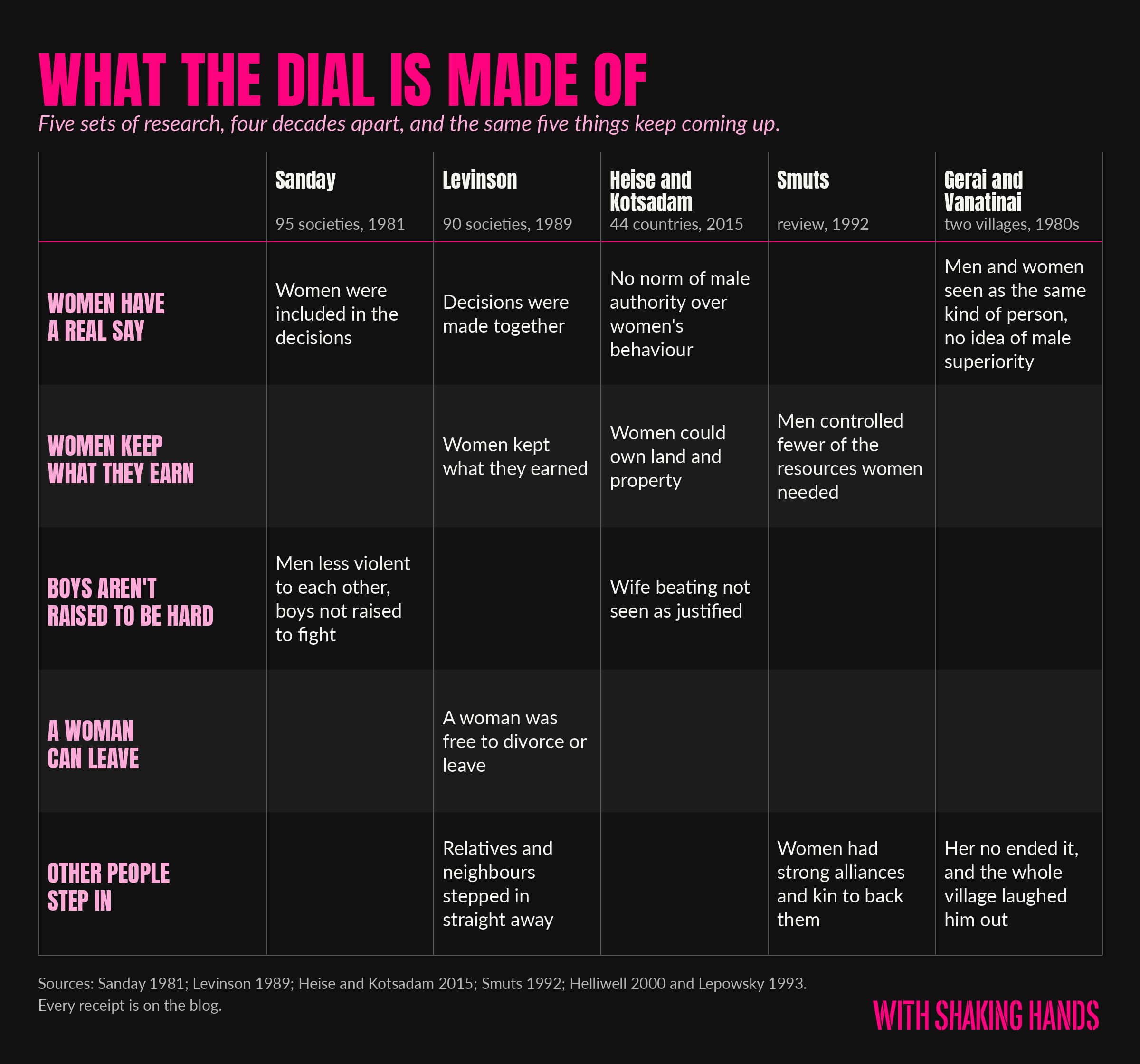
Table 1: What the dial is made of. Five sets of research, from 1981 to 2015, each measuring something different, and the same five conditions turn up again and again. Every source is in the receipts at the bottom.
So the five things are that women get to have a real say, women keep what they earn, boys are not raised to be ‘hard’, a woman is able to leave, and other people intervene when a man is violent. As far as I can tell, from sifting through all this research, that’s what the dial is made up of, and none of it is a law, religion, race, or skin colour and 9 times out of 10 it’s a man.
I’d also like to quickly reiterate that these aren’t actually matriarchies. One of the most liked comments under my first reel with 2,919 likes was “hint, they’re matriarchies”. Now I get why people liked it. Us women, we’re all sick of the patriarchy here, but what Sanday found was that societies with flat structures work better. In the ones she studied, nobody had women ruling over men. The Gerai saw men and women as the same kind of person [3], Vanatinai had ‘no ideology of male superiority’ [4], and even the Minangkabau, who call themselves a matriarchy, give the formal jobs to men [32] (they’re actually matrilineal). Swapping a patriarchy for a matriarchy won’t make a huge change, because all that’s swapped is who’s in charge.
So what about us here in Britain? Well ‘Women have a say’, mostly, and on paper at least. ‘Women have kept what they earn’ since 1870 [45]. A ‘woman can leave’, although with the lack of refuge beds it’s harder than it should be. ‘Boys aren’t raised to be hard’, well, tell that to any boy who’s cried in a playground. And then there’s ‘other people stepping in’, which to me is one of the most important things we should be looking at today. Levinson found that violence continued when no one intervened and dropped where neighbours and family did [6]. But that was 1989. In 2026 boys and men are watching violence pretty much unchecked on social media. I see it myself daily, with men being violent to women under my reels, where they threaten and mock them. Nobody steps in, which in this case could and should be the platform, but thus far they haven’t actioned a single report I’ve made. And I’ve not seen any other men stepping in. These audiences are massive, and boys are watching it daily, for hours on end. This doesn’t bode well as far as I’m concerned and I can’t see things getting better until we get a proper handle on it. Smart phones and social media need proper rules and regulation.
Sanday wrote that “Male dominance is not an inherent quality of human sex-role plans” [31] and Lepowsky wrote that “the subjugation of women by men is not a human universal, and it is not inevitable” [4]. After a ton of research and thoroughly going through nearly all of it, I believe the two women who lived there for years and I think the theory stacks up.
If I had control of the dial tomorrow I’d start with “other people step in”, because it’s free, and by comparison, easy. And by that I mean online, in the pub, friends, group chats, family, in the playground and when it’s your mate. The Gerai woman shoved him out, told everyone what he tried to do and embarrassed him, with the whole village laughing about it in the morning. That didn’t require any law.
Look, if a village in Borneo can laugh a man out of a mosquito net, and if Rwanda and 94% of the countries anyone has properly measured can move the dial [12, 16], then we can bloody well do it here, and really I’d rather spend my time turning it than arguing about whether it exists, wouldn’t you?
The Receipts // (Sources)
[1] Peggy Reeves Sanday, The Socio-Cultural Context of Rape: A Cross-Cultural Study, Journal of Social Issues, vol 37 no 4, 1981.
[2] Peggy Reeves Sanday, Rape-Prone Versus Rape-Free Campus Cultures, Violence Against Women, vol 2 no 2, June 1996.
[3] Christine Helliwell, "It's Only a Penis": Rape, Feminism, and Difference, Signs, vol 25 no 3, 2000.
[4] Maria Lepowsky, Fruit of the Motherland: Gender in an Egalitarian Society, Columbia University Press, 1993.
[5] Maria Lepowsky, Women, Men, and Aggression in an Egalitarian Society, Sex Roles, vol 30 no 3, 1994.
[6] David Levinson, Family Violence in Cross-Cultural Perspective, Sage, 1989.
[7] Claudia Garcia-Moreno, Henrica Jansen, Mary Ellsberg, Lori Heise and Charlotte Watts, Prevalence of intimate partner violence: findings from the WHO multi-country study on women's health and domestic violence, The Lancet, vol 368, 2006.
[8] Lynnmarie Sardinha, Mathieu Maheu-Giroux, Heidi Stöckl, Sarah Meyer and Claudia García-Moreno, Global, regional, and national prevalence estimates of physical or sexual, or both, intimate partner violence against women in 2018, The Lancet, 2022.
[9] World Health Organization, Lifetime toll: 840 million women faced partner or sexual violence, news release, 19 November 2025.
[10] World Health Organization, Violence against women, fact sheet, 18 June 2026.
[11] Lori Heise and Andreas Kotsadam, Cross-national and multilevel correlates of partner violence: an analysis of data from population-based surveys, The Lancet Global Health, vol 3 no 6, 2015.
[12] Kristin Dunkle, Erin Stern, Sangeeta Chatterji and Lori Heise, Effective prevention of intimate partner violence through couples training: a randomised controlled trial of Indashyikirwa in Rwanda, BMJ Global Health, vol 5, 2020.
[13] Not used.
[14] Office for National Statistics, Domestic abuse victim characteristics, England and Wales: year ending March 2020, 25 November 2020.
[15] Office for National Statistics, Domestic abuse prevalence and trends, England and Wales: year ending March 2020, 25 November 2020.
[16] Irina Vartanova, Kimmo Eriksson and Pontus Strimling, Trends in the acceptability and prevalence of intimate partner violence: Evidence from Demographic and Health Surveys, 1999 to 2024, PLOS Global Public Health, 2026.
[17] Craig Palmer, Is Rape a Cultural Universal? A Re-examination of the Ethnographic Data, Ethnology, vol 28 no 1, 1989.
[18] Craig Palmer and Randy Thornhill, A Posse of Good Citizens Brings Outlaw Evolutionists to Justice, Evolutionary Psychology, vol 1 no 1, 2003; and MIT Press description of A Natural History of Rape, 2000.
[19] Barbara Smuts, Male aggression against women: An evolutionary perspective, Human Nature, vol 3 no 1, 1992.
[20] Shawn Geniole and colleagues, Is testosterone linked to human aggression? A meta-analytic examination of the relationship between baseline, dynamic, and manipulated testosterone on human aggression, Hormones and Behavior, 2019; Robert Sapolsky, Testosterone's Bum Rap, in Behave, 2017.
[21] Matteo Pazzona, Revisiting the Income Inequality-Crime Puzzle, World Development, vol 176, 2024.
[22] Ching-Chi Hsieh and M. D. Pugh, Poverty, Income Inequality, and Violent Crime: A Meta-Analysis of Recent Aggregate Data Studies, Criminal Justice Review, vol 18 no 2, 1993.
[23] Amy Nivette, Cross-National Predictors of Crime: A Meta-Analysis, Homicide Studies, vol 15 no 2, 2011.
[24] Martin Daly, Margo Wilson and Shawn Vasdev, Income inequality and homicide rates in Canada and the United States, Canadian Journal of Criminology, vol 43 no 2, 2001.
[25] Pablo Fajnzylber, Daniel Lederman and Norman Loayza, Inequality and Violent Crime, Journal of Law and Economics, vol 45 no 1, 2002.
[26] Not used.
[27] Peter Saunders, Beware False Prophets: Equality, the Good Society and The Spirit Level, Policy Exchange, July 2010; and The Equality Trust, Beware False Rebuttals, 2010.
[28] European Union Agency for Fundamental Rights, Violence against women: an EU-wide survey, Results at a glance, 2014.
[29] not used.
[30] Anne Laure Humbert, Sofia Strid, Jeff Hearn and Dag Balkmar, Undoing the "Nordic Paradox": Factors affecting rates of disclosed violence against women across the EU, PLOS ONE, vol 16 no 5, 2021.
[31] Peggy Reeves Sanday, Female Power and Male Dominance: On the Origins of Sexual Inequality, Cambridge University Press, 1981.
[32] Peggy Reeves Sanday, Women at the Center: Life in a Modern Matriarchy, Cornell University Press, 2002.
[33] Not used.
[34] Not used.
[35] Megan Kearns, Ashley D'Inverno and Dennis Reidy, The Association Between Gender Inequality and Sexual Violence in the U.S., American Journal of Preventive Medicine, vol 58 no 1, 2020 (online November 2019).
[36] Not used.
[37] Martin Daly, Killing the Competition: Economic Inequality and Homicide, Russell Sage Foundation, 2016.
[38] Mary Ellsberg and colleagues, Prevention of violence against women and girls: what does the evidence say?, The Lancet, vol 385, 2015.
[39] Kevin Beaver, J. C. Barnes and Brian Boutwell (eds), The Nurture Versus Biosocial Debate in Criminology, SAGE, 2014, contents.
[40] Not used.
[41] United Nations Security Council, S/2003/674, letter of 2 July 2003 transmitting the MONUC Special Investigation Team report on events in Mambasa, Ituri, 31 December 2002 to 20 January 2003 (Opération Effacer le tableau).
[42] Office for National Statistics, Nature of sexual assault by rape or penetration, England and Wales: year ending March 2020, 18 March 2021.
[43] United Nations Office on Drugs and Crime, Global Study on Homicide 2019, press release of 8 July 2019 (UN Information Service, Vienna).
[44] Robert Sapolsky, The Trouble with Testosterone, in The Trouble with Testosterone and Other Essays on the Biology of the Human Predicament, Scribner, 1997.
[45] UK Parliament, Living Heritage: Property and children, Married Women's Property Acts 1870 and 1882.
[46] David Åkerlund, Bart Golsteyn, Hans Grönqvist and Lena Lindahl, Time discounting and criminal behavior, Proceedings of the National Academy of Sciences, vol 113 no 22, 2016.
[47] United Nations, Department of Economic and Social Affairs, Population Division, World Population Prospects: The 2024 Revision.
Sources correct as at 3 November 2026.